

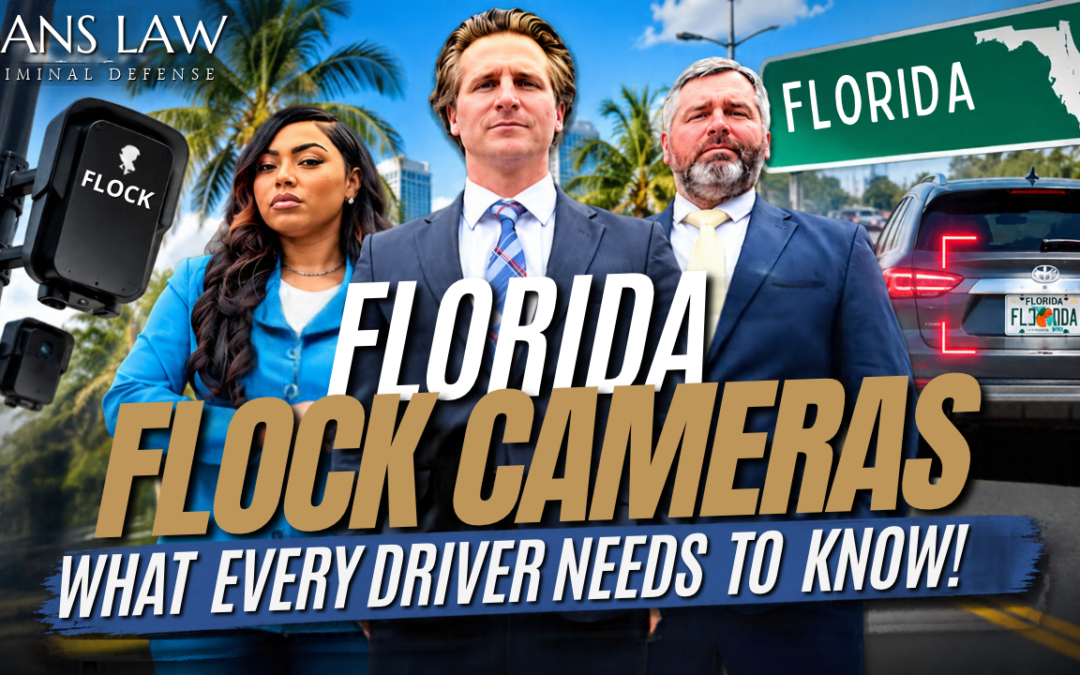
Flock Cameras in Florida: Are Police Tracking Your Every Move?
What Florida drivers need to know about automated license plate readers, privacy rights, and the Fourth Amendment.
Imagine driving to work, dropping your children off at school, visiting your doctor, or stopping at the grocery store. What if law enforcement could access records showing where your vehicle has traveled, even when you haven’t committed a crime?
This is the growing concern surrounding Flock cameras in Florida, a surveillance technology that has sparked debate over privacy, constitutional rights, and law enforcement practices.
In a recent episode of Badges to Briefcases, the Gans Law podcast, criminal defense attorneys Brandon Gans, Ian Wise, and Danielle Padilla discuss how automated license plate readers work, why they are controversial, and how the information they collect could impact criminal cases.
With backgrounds in law enforcement, our attorneys offer a unique perspective on the benefits and potential dangers of this technology.
What Are Flock Cameras, and How Do They Work?
Flock cameras are a type of automated license plate reader (ALPR) designed to capture and record information about vehicles traveling on public roads.
Unlike traditional traffic cameras, which may monitor traffic conditions or document specific violations, ALPR systems can collect license plate information and make it searchable through a database.
These systems can potentially:
- Capture license plate numbers from passing vehicles.
- Record the time and location of a vehicle sighting.
- Alert law enforcement when a plate matches certain records.
- Store historical vehicle-location information.
- Allow authorized agencies to search previously collected data.
- Help investigators identify vehicle travel patterns.
One of the biggest concerns is that these cameras collect information about everyday drivers, not just individuals suspected of criminal activity.
This means your license plate could be recorded while you’re simply going about your daily routine.
How Are Flock Cameras Different From Regular Traffic Cameras?
Many Florida drivers are familiar with red-light cameras, traffic monitoring systems, and speed enforcement cameras.
However, Flock cameras serve a different purpose.
Traditional traffic cameras generally focus on monitoring roadways or documenting specific traffic violations. Automated license plate readers can create searchable records of vehicle movements over time.
During the podcast, Attorney Ian Wise explains that the major difference is not necessarily the camera itself, but what happens to the information afterward.
Instead of requiring someone to manually review hours of footage, an ALPR system can rapidly search stored records to identify when and where a particular license plate was detected.
That capability raises an important question:
At what point does monitoring public roads become surveillance of someone’s private life?
Can Police Track Your Vehicle Without a Warrant in Florida?
This is one of the most controversial legal questions surrounding Flock cameras.
The Fourth Amendment to the United States Constitution protects individuals against unreasonable government searches and seizures.
Generally, drivers have a reduced expectation of privacy when traveling on public roadways. However, collecting extensive historical location information can raise different constitutional concerns.
In the podcast, Attorney Wise discusses Carpenter v. United States, a U.S. Supreme Court decision addressing government access to historical cell-site location information.
The case recognized that extensive location records can reveal highly personal details about someone’s life.
Although cell phone location records and automated license plate reader databases involve different technologies, similar privacy concerns may arise when police use historical ALPR information to reconstruct someone’s movements.
Does that mean police always need a warrant to access Flock camera records?
Not necessarily. The legal requirements depend on the circumstances, applicable laws, and developing court decisions. Whether a particular ALPR search violates the Fourth Amendment remains an important area of legal debate.
At Gans Law, our criminal defense attorneys understand that technology does not eliminate constitutional protections.
Could Flock Cameras Reveal Your Daily Routine?
Think about how often you drive the same routes.
You might leave home at the same time every morning, take your children to school, stop at the gym, or visit family members every weekend.
When vehicle-location records are collected over time, they can potentially reveal patterns about your life.
During the podcast, Attorney Danielle Padilla raises concerns about how this information could affect families, particularly when vehicle movements reveal children’s daily routines.
Historical location information could potentially expose:
- Where someone works or attends school.
- Regular medical appointments.
- Religious or community activities.
- Frequent visits to particular locations.
- Children’s school drop-off and pickup routines.
- Personal relationships and daily habits.
The concern is not simply that a camera captures a vehicle passing through an intersection.
It is that a searchable database may allow someone to reconstruct portions of a person’s life without physically following them.
For many Florida residents, that distinction is at the center of the privacy debate.
Can Flock Cameras Help Police Solve Crimes?
Yes. Automated license plate readers can provide valuable investigative leads.
During the episode, Attorney Wise shares his experience using license plate reader technology as a former police officer.
His patrol vehicle was equipped with cameras that automatically scanned license plates and compared them against records of stolen vehicles.
When the system identified a possible match, he could verify the information before taking further action.
These systems can help law enforcement locate stolen vehicles, identify vehicles connected to investigations, and respond to urgent public safety situations.
However, Attorney Wise explains that there is an important difference between receiving a real-time alert about a stolen vehicle and searching months of historical location records to investigate someone’s activities.
The debate is not simply whether Flock cameras can help police. It is whether the collection, retention, and use of that information have sufficient constitutional safeguards.
What Happens If Police Use Flock Camera Evidence Against You?
Imagine someone borrows your vehicle and drives it to a location connected to a criminal investigation.
Later, police identify your license plate in surveillance records.
Does that automatically prove you were driving?
No. A license plate identifies a vehicle, not necessarily the person operating it.
Attorney Brandon Gans and the Gans Law team discuss why investigators must be careful when connecting vehicle records to individual suspects.
A vehicle could be driven by a spouse, family member, friend, or another authorized driver.
If investigators rely too heavily on license plate records without additional evidence, they risk making incorrect assumptions.
This is particularly important in criminal defense cases involving vehicle-related allegations.
Can a Criminal Defense Attorney Challenge Flock Camera Evidence?
Absolutely.
When automated license plate reader evidence is used in a criminal investigation, a defense attorney can examine how that information was obtained and whether its use complied with applicable law.
At Gans Law, our attorneys may investigate questions such as:
- How was the information obtained? Was it collected through a real-time alert or a historical database search?
- Why did law enforcement access the records? What information or legal justification supported the investigation?
- How long was the information stored? Did the agency follow applicable retention rules?
- Was the information accurate? Could the license plate have been misread or incorrectly associated with a vehicle?
- Were constitutional rights violated? Does the manner in which law enforcement obtained the evidence support a Fourth Amendment challenge?
Depending on the circumstances, an attorney may seek to suppress evidence obtained through an unlawful search.
However, suppression is not automatic, and every case must be evaluated individually.
During the podcast, Attorney Wise discusses successfully obtaining the dismissal of a felony charge in a case involving the improper use of automated license plate reader information.
That experience highlights why examining the methods used by law enforcement can be just as important as examining the evidence itself.
Why Florida Drivers Should Pay Attention to Flock Cameras
Surveillance technology continues to evolve, and the law must address questions that did not exist when many constitutional protections were first interpreted.
For Florida drivers, the growing use of automated license plate readers raises several important issues.
Who can access your vehicle-location information? How long can it be retained? What safeguards prevent misuse? And when should law enforcement be required to obtain a warrant?
These questions affect more than people accused of crimes.
They concern the privacy and constitutional protections of everyone who uses Florida’s roadways.
At Gans Law, we believe that effective law enforcement and constitutional accountability must go hand in hand.
Watch Badges to Briefcases: Are Flock Cameras Legal in Florida?
Want to hear more about how Flock cameras work and what they mean for your constitutional rights?
Watch our latest episode of Badges to Briefcases, where Attorneys Brandon Gans, Ian Wise, and Danielle Padilla discuss automated license plate readers, police surveillance, and the Fourth Amendment.
With firsthand law enforcement experience and extensive criminal defense knowledge, our attorneys break down the issues Florida drivers should understand.
Watch the full episode on our YouTube channel and subscribe to Badges to Briefcases for more discussions about Florida criminal law.
Facing Criminal Charges in Central Florida? Contact Gans Law.
If you are facing criminal charges involving surveillance evidence, a traffic stop, or another law enforcement investigation, having an experienced criminal defense attorney can make a difference.
At Gans Law, our legal team is made up of former law enforcement officers, including founding attorney Brandon Gans, who also served as a state prosecutor.
We understand how criminal investigations are conducted, how evidence is collected, and how to identify potential weaknesses in the prosecution’s case.
Our firm represents clients throughout Central Florida, including Orange, Seminole, and Osceola counties.
We offer:
- Free consultations.
- Flat-fee representation with trial included.
- Criminal defense attorneys with former law enforcement experience.
- Defense strategies tailored to the facts of your case.
Everyone Deserves Justice.
Contact Gans Law today to discuss your case and learn how our team can help protect your rights.
Disclaimer: This article is for general informational purposes only and does not constitute legal advice. Laws and court decisions involving surveillance technology continue to develop. Every criminal case is different, and outcomes depend on the specific facts and applicable law.
Recent Comments