

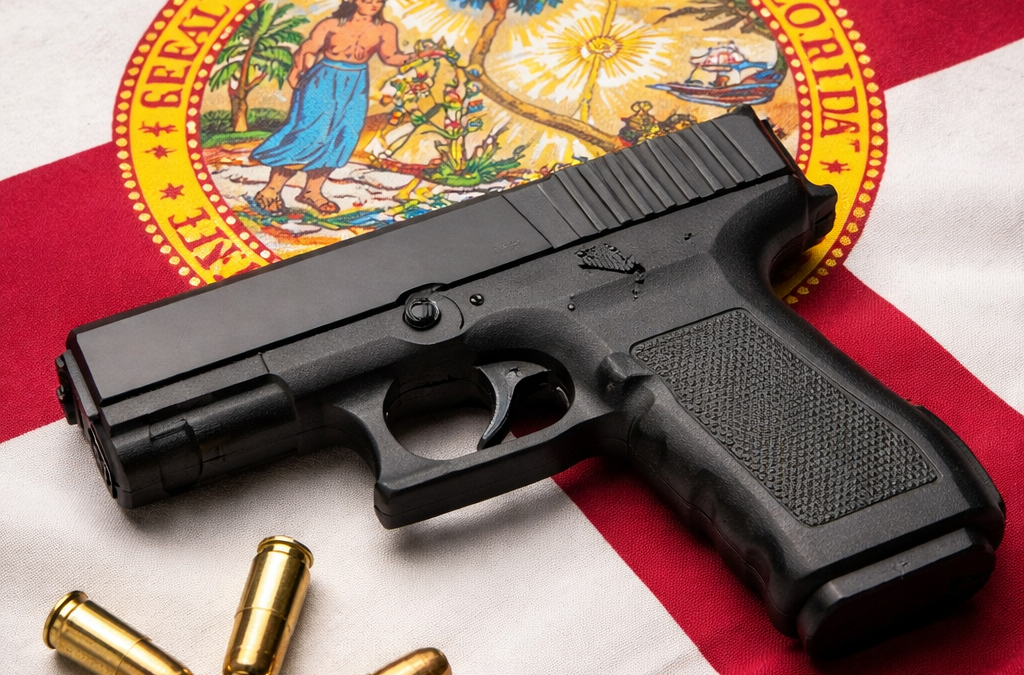
Understanding Florida firearm laws can be confusing—especially when it comes to having a gun inside your vehicle. Even experienced gun owners sometimes misunderstand the rules, and unfortunately, those misunderstandings can lead to serious criminal charges.
At Gans Law, we regularly see cases where someone is charged simply because the law is unclear or interpreted differently by officers, prosecutors, or even judges. Below are some of the most common questions and misconceptions surrounding firearms in vehicles under Florida law.
When a Firearm in a Car Is Considered Concealed
One of the key issues people ask about is whether a firearm inside a vehicle is considered concealed.
Generally speaking, if a firearm is inside a vehicle and not being brandished or used to threaten anyone, it may still be considered concealed depending on how it is stored. For example, if someone is sleeping in their car and the firearm is simply present inside the vehicle without being displayed or used in a threatening manner, there may be no criminal conduct occurring at all.
However, every situation depends on the specific facts. Law enforcement officers may interpret circumstances differently, which is why it’s important to understand how Florida law approaches firearm possession in vehicles.
“Securely Encased” vs. “Not Readily Accessible”
One of the most misunderstood parts of Florida firearm law involves the phrase:
“Securely encased or otherwise not readily accessible.”
Many people mistakenly believe that both requirements must be met at the same time. In reality, the law uses the word “or,” which means either condition may satisfy the statute.
Examples that may qualify as securely encased can include:
-
A firearm inside a holster
-
A firearm in the glove compartment
-
A firearm stored in the center console
-
A firearm inside a closed case or container
There is no single bright-line rule that defines exactly what counts as securely encased, which is part of why these cases can become complicated. Different officers—and sometimes courts—may interpret the same situation differently.
The Myth of the “Three-Step Rule”
Another common myth is the idea that a firearm must follow a “three-step process” in order to be legal inside a vehicle.
This supposed rule has circulated online and in gun forums for years, but it does not exist in Florida law.
Some early legal interpretations decades ago suggested that multiple steps might be required to access a firearm, but modern Florida statutes do not require a three-step process. Instead, the legal language focuses on whether the firearm is securely encased or otherwise not readily accessible.
Because the law does not clearly define every situation, people can still find themselves facing charges even when they believe they are complying with the law.
Is Your Car an Extension of Your Home?
Another question people often ask is whether a car is considered an extension of your home under Florida law.
Legally speaking, Florida law distinguishes between three different concepts:
-
Dwelling – A residence where someone lives
-
Structure – A building that is not used as a residence
-
Conveyance – A means of transportation, such as a car
A dwelling receives the strongest legal protections, including those associated with the Castle Doctrine.
A vehicle is typically classified as a conveyance, which means it does not receive the same level of protection as a home. However, in certain situations—such as when someone is inside their vehicle during a carjacking—the law may allow them to defend themselves.
The key distinction is that self-defense laws focus on protecting people, not property. In other words, the law generally allows reasonable force to protect yourself, but the rules surrounding deadly force depend heavily on the specific threat involved.
Why Gun Charges Often Start in Vehicles
Many firearm arrests in Florida happen during traffic stops. This is partly because vehicle firearm laws are complicated and sometimes unclear.
Officers may interpret situations differently, especially when determining whether a firearm is:
-
On a person
-
About a person
-
Securely encased
-
Readily accessible
Even when charges are later dismissed in court, people can still face:
-
Arrest
-
Seizure of their firearm
-
Legal fees
-
Months of court proceedings
That’s why understanding the law—and having the right legal defense when issues arise—is critical.
Why Legal Interpretation Matters
Florida firearm laws are often written in ways that leave room for interpretation. While that can create opportunities for strong legal defenses, it also means that ordinary citizens can find themselves caught in legal gray areas.
At Gans Law, we regularly defend clients charged with firearm offenses that stem from misunderstandings of these complicated statutes. Our team carefully examines the facts, the language of the law, and the officer’s interpretation to build the strongest defense possible.
Facing a Firearm Charge in Florida?
If you or someone you know has been charged with a firearm offense in Florida, it is important to speak with a defense attorney as soon as possible. Gun charges can carry serious penalties, but in many cases there may be defenses available.
Gans Law is here to help.
📞 Contact us today to discuss your case and learn how we can protect your rights.

Recent Comments